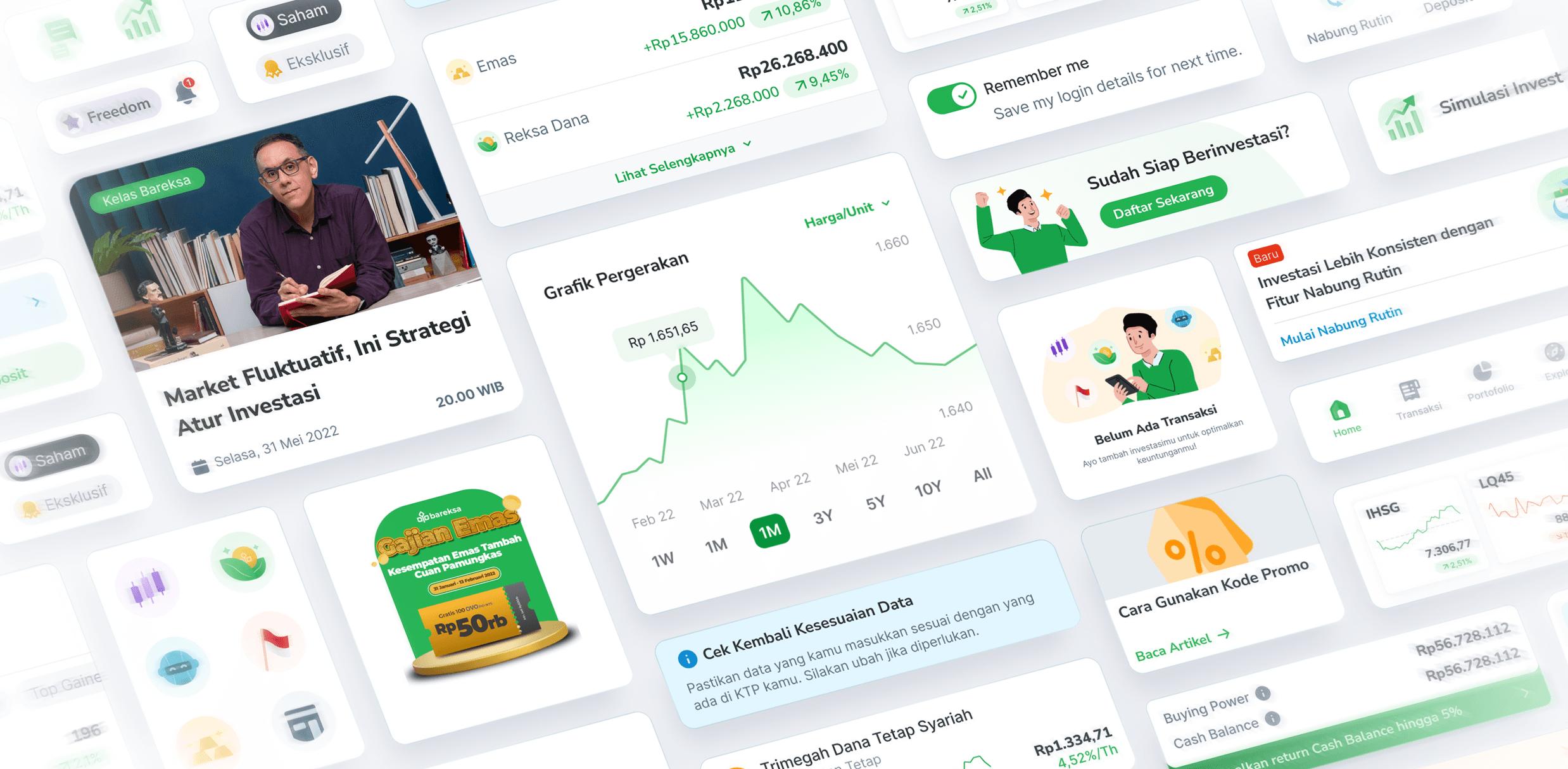
INFO
Role:
Designer in Charge
Company:
Bareksa
Year:
2023-2024
Professional Work
Onboarding
SUMMARY
Flexible and Scalable User-Centric Journey
The initial onboarding at Bareksa, which was originally designed for a single investment product, had to be completely restructured to accommodate onboarding for all products from the start of user registration. This change introduced a series of challenges that required a complete redesign of the entire onboarding journey and verification workflow.
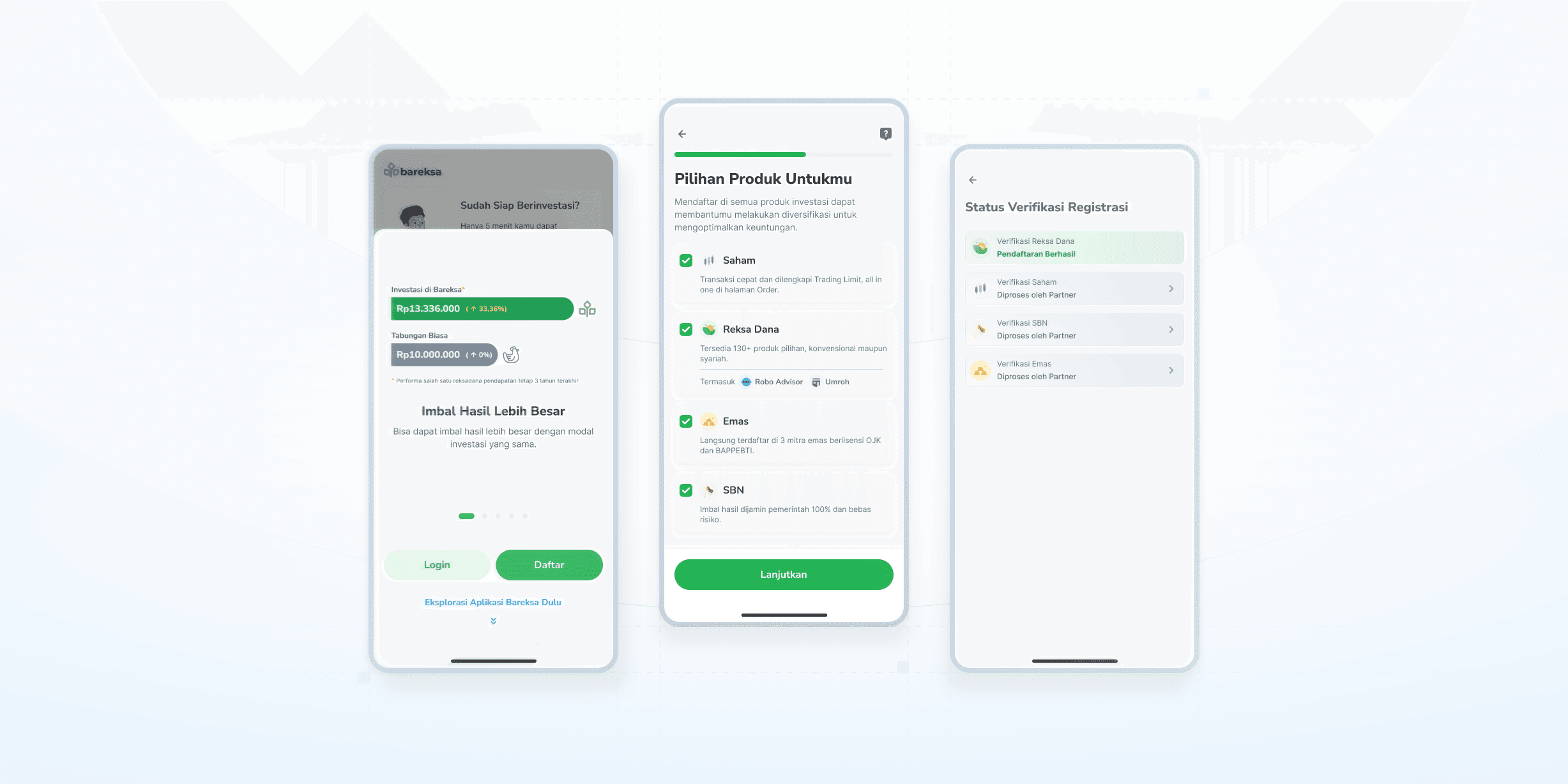
The proposal is to create an onboarding journey with modular “puzzle-like” approach, enabling users to flexibly register for specific or even multiple products they want to invest in.This approach makes the onboarding journey more user-centric, flexible, and scalable, aligning with Bareksa's vision of becoming a true Investment Super App.
Proposed concept of modular approach for onboarding flow.
BACKGROUND
The Existing Onboarding
Bareksa is one of the pioneering investment platforms in Indonesia, initially offering Mutual Funds as its core product. Over time, it expanded to include four major investment products: Mutual Funds, Government Bonds (SBN), Gold, and Stocks. However, the incremental addition of these products resulted in several outdated and fragmented user journeys. One that was directly impacted is the onboarding flow.
The journey requires users to go through an account creation process followed by a KYC process for Mutual Funds only, regardless of their actual product interest.

High-level flow of the onboarding journey before the revamp.
For users whose primary interest lies in products other than Mutual Funds, this becomes a hurdle. It introduces unnecessary steps, reduces efficiency, and increases the chance of drop-offs, especially considering that over 80 percent of Bareksa users hold portfolios beyond Mutual Funds.
Research Insights
The Data Team identified that in the first half of 2022, there was a consistent decline in new user registrations. Upon further investigation, the Research Team found that this trend was influenced not only by external factors such as increasing competition, but also by several factors within the onboarding experience.
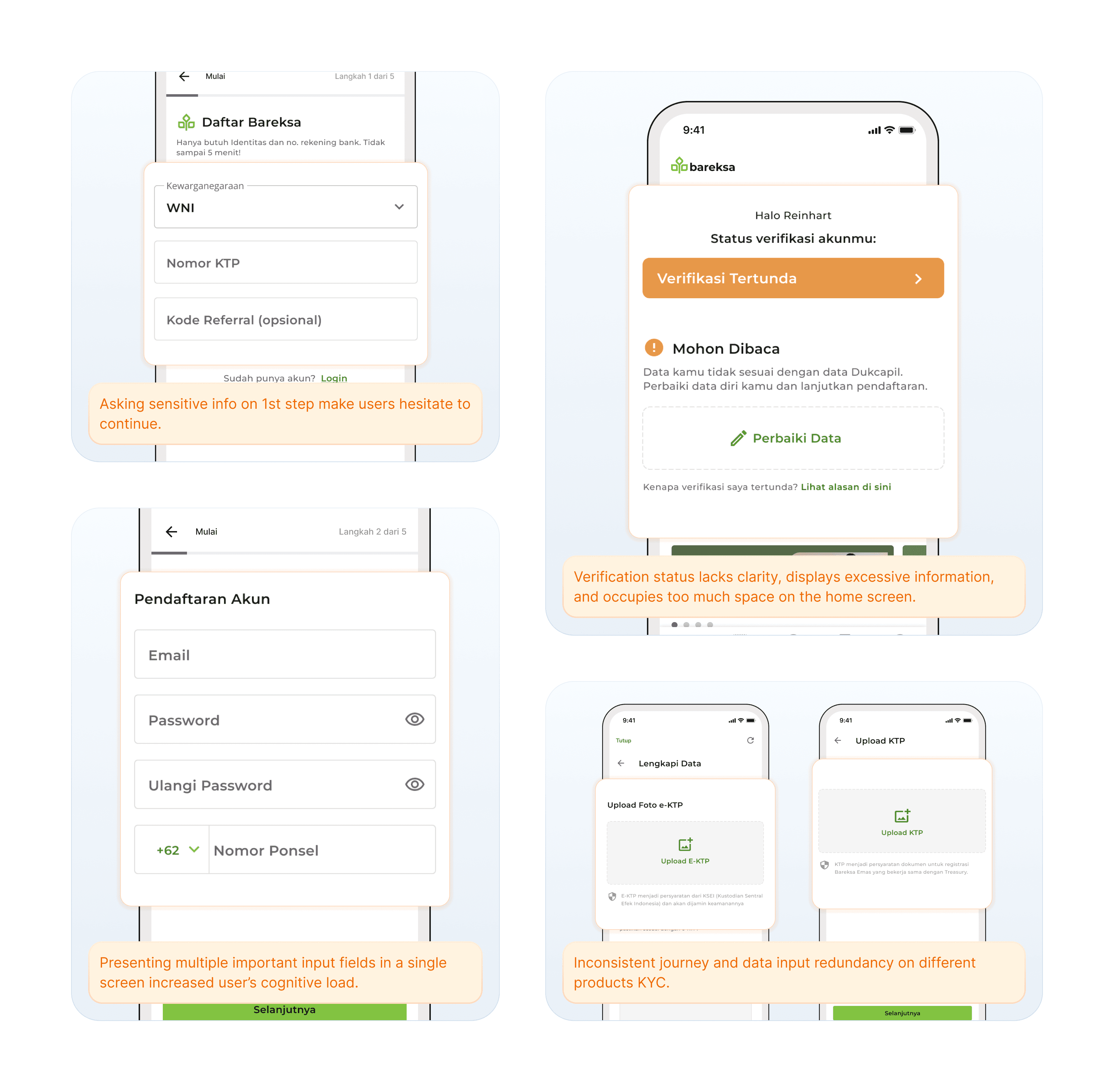
Some findings from the existing journey.
Project Scope & Involvement
The onboarding revamp was one of the most strategic product-initiated projects at Bareksa. This project involved the redesign of the onboarding flow within the app, a new internal dashboard for the Operations team with adjustment to their registration and verification workflow, and a large-scale data migration that required significant tech effort.
I joined effectively in this project in the phase of design exploration, receiving handover from previous designer. As the sole designer I was responsible for the end-to-end journey of the new onboarding within the Bareksa app. My scope included from initial account creation, products KYC, to post-registration flow, and also various supporting details.
Key Objectives
Based on the background and key findings, the product team created objectives for the end-to-end improvement of the overall onboarding experience. These objectives aim to address both user pain points and product scalability challenges:
1. Provide flexibility for users to choose investment product(s).
2. Reduce drop-off rates during the end-to-end journey.
3. Build a seamless and scalable onboarding flow with the new design system.
THE PROCESS
Mapping the Requirements
When the project started, Bareksa had four main investment products: Mutual Funds, Gold, Government Bonds (SBN), and Stocks. Each product required user-registration data, some of which overlapped, while others were unique to each product.
To begin, the Product Manager and Product Designer collaborated to map out the user flow and data requirements for each product. This process included cross-checking with the operations team and external partners to ensure that only the necessary inputs and data were included for all product registrations.
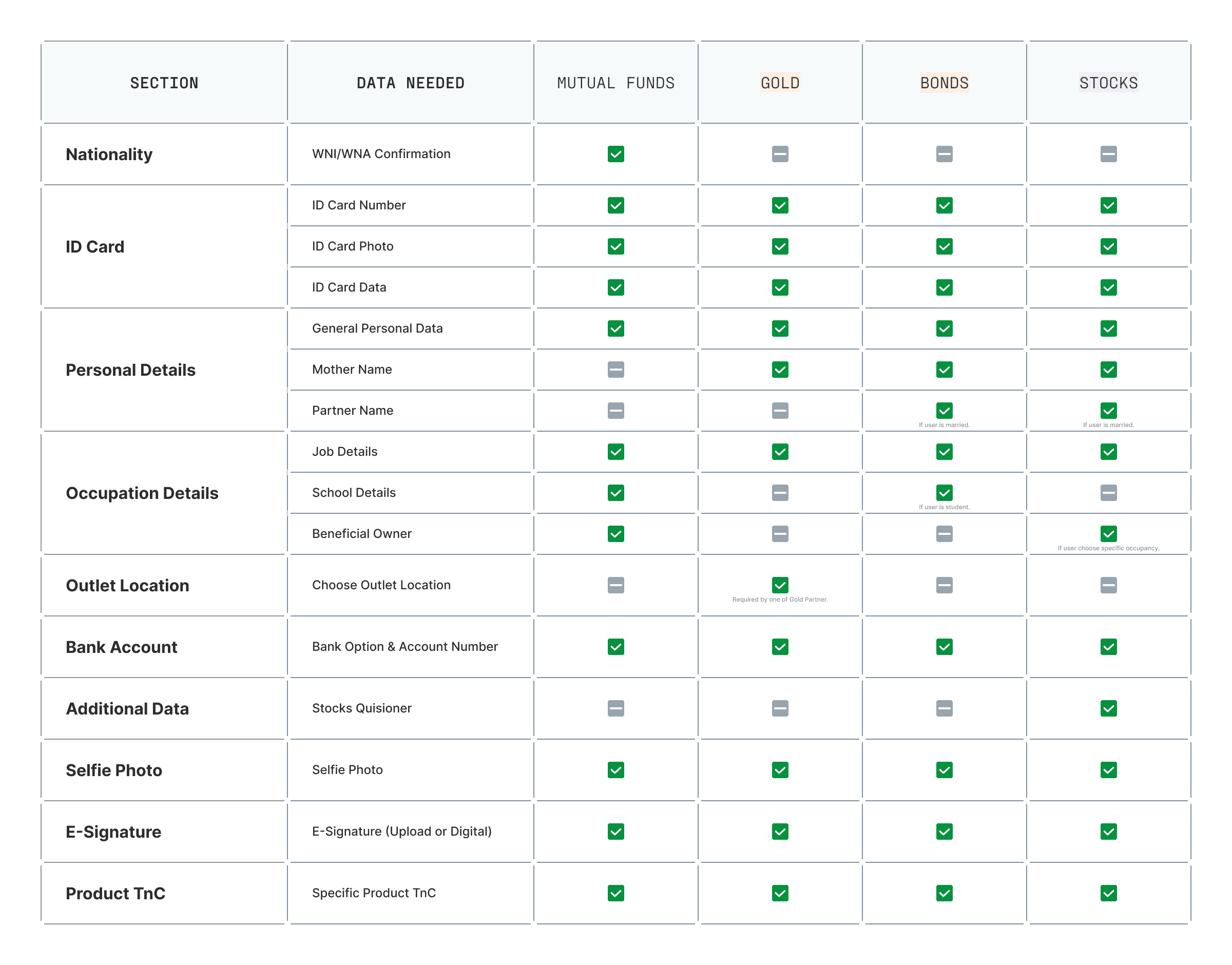
Final mapping of required data for each product registration.
Finding the Best Approach
After identifying the issues in the existing onboarding and mapping the required data, the team explored ideas and opportunities through brainstorming with stakeholders and cross-team collaboration, especially between product, engineer, and operation team.
The main concern was how to enable users to choose the investment product they want to register on their initial registration on Bareksa. The proposed solution is to restructure the overall flow by clearly separating the data required for account creation from the data needed for product-specific KYC.
In the middle of the registration process, users would be given the option to select which investment product they want to proceed with. After selecting the investment products, they would continue the onboarding journey tailored specifically based on their chosen products.


High-level flow improvement for the new onboarding.
From that high-level flow, we proposed creating flexible and reusable data-input components. Instead of designing separate, hard-coded flows for each product, we create a system where required user data acts like modular sections. These sections could be configured and combined depending on user’s selected product.
Visualization of how the modular-system flow works.
Visual Exploration
In carried out the UI explorations, one of the key principles was to ensure that users only need to input one important data per page so users don't get overwhelmed by cognitive load (Miller’s Law). This approach helps reduce drop-off rates, simplifies the flow, and minimizes potential edge cases. The overall structure of the onboarding UI template remained largely consistent throughout the design.
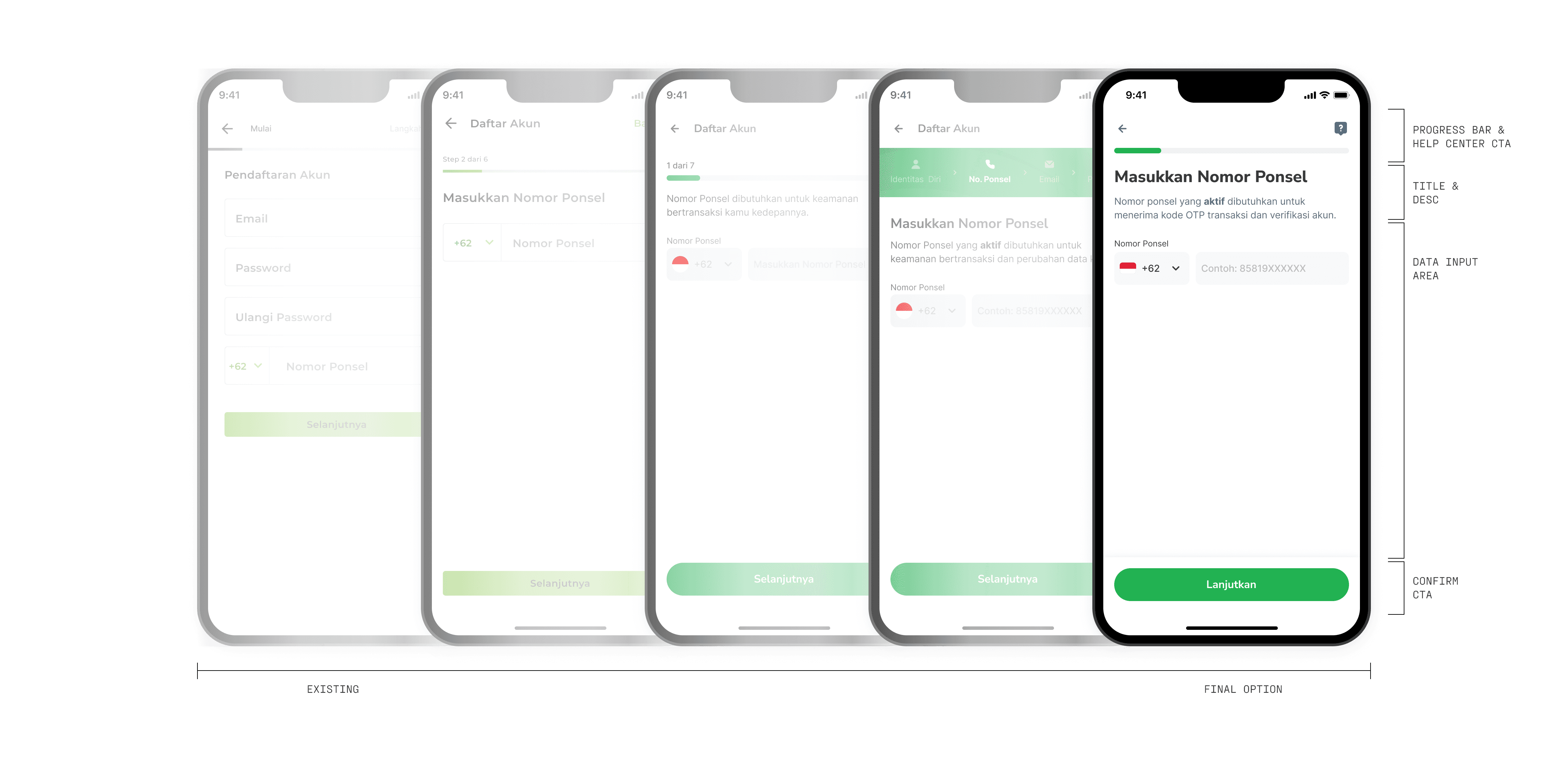
Changes from the previous onboarding page to the new design.
In addition to general onboarding screens, I also explored visuals in some journeys to make the experience more engaging and adding clarity to the user.
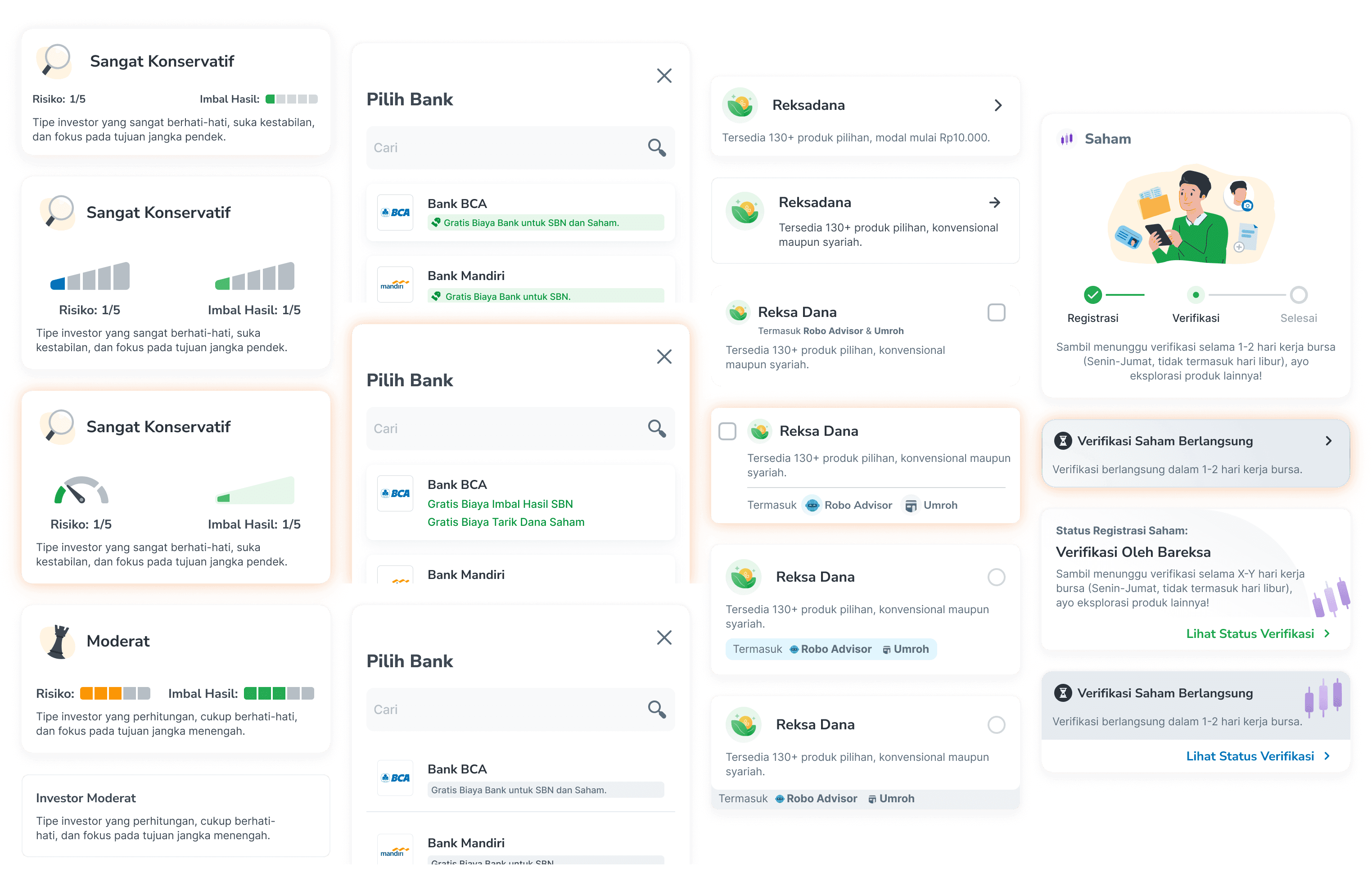
A preview of some visual explorations.
Covering Complex Edge Cases
One of the critical aspects of this project was identifying and addressing edge cases. In some cases, mapping and solving edge cases takes more effort than designing the regular flow. We thoroughly identify every potential edge case across the onboarding journey and worked on solutions for each of them:
User Drop-Off
The most common occurrence in onboarding journeys is users drop-off. In the existing onboarding, there were no reminders or recovery mechanisms in place. Users who reopened the app after dropping off were forced to start from the beginning.
In the new onboarding flow, if a user exits the app mid-onboarding, they will receive reminders (via push notification/email) and can resume the registration process from the last completed step, rather than starting over.
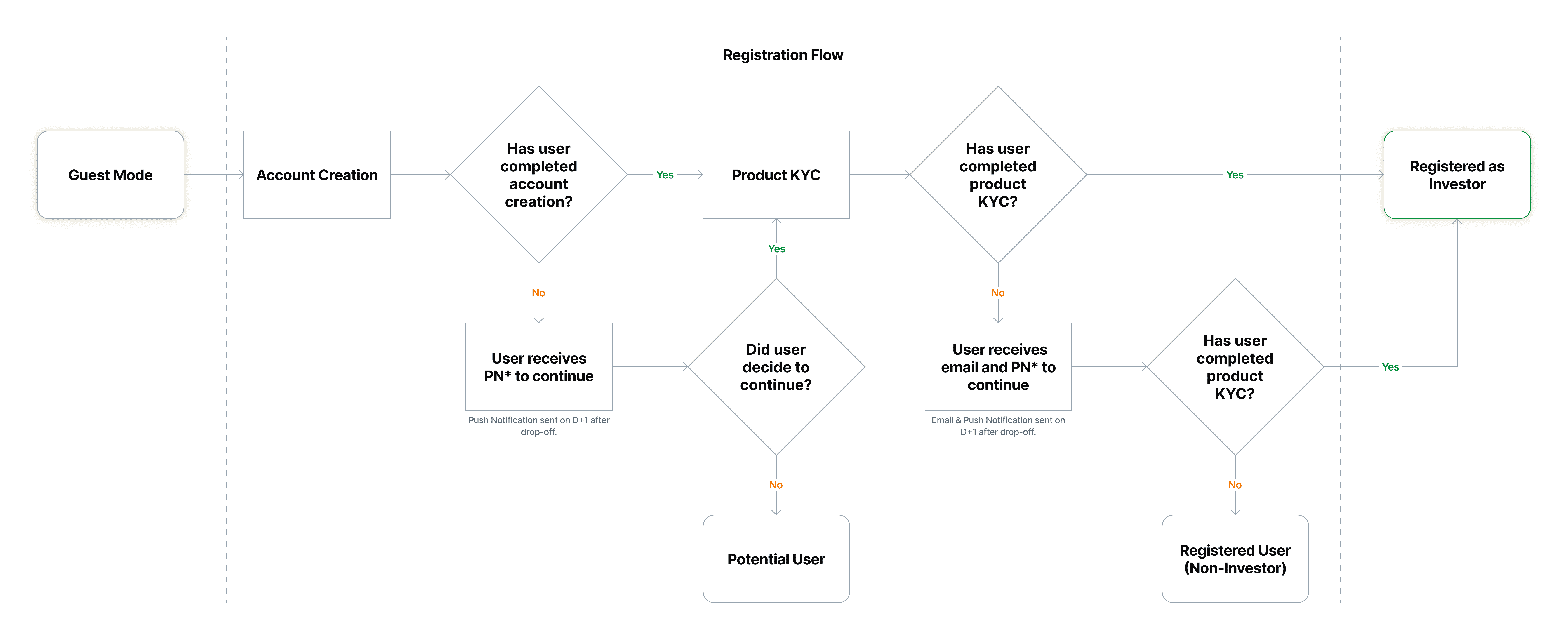
User drop-off flow.
Back Navigation Flow
In an straightforward user flow, the back action simply returns the user to the previous screen without additional considerations. But in some cases, the back flow requires deeper consideration. For example, where certain data has already been verified (such as phone number and email), the back flow requires careful handling to prevent re‑verification errors or potential security risks.
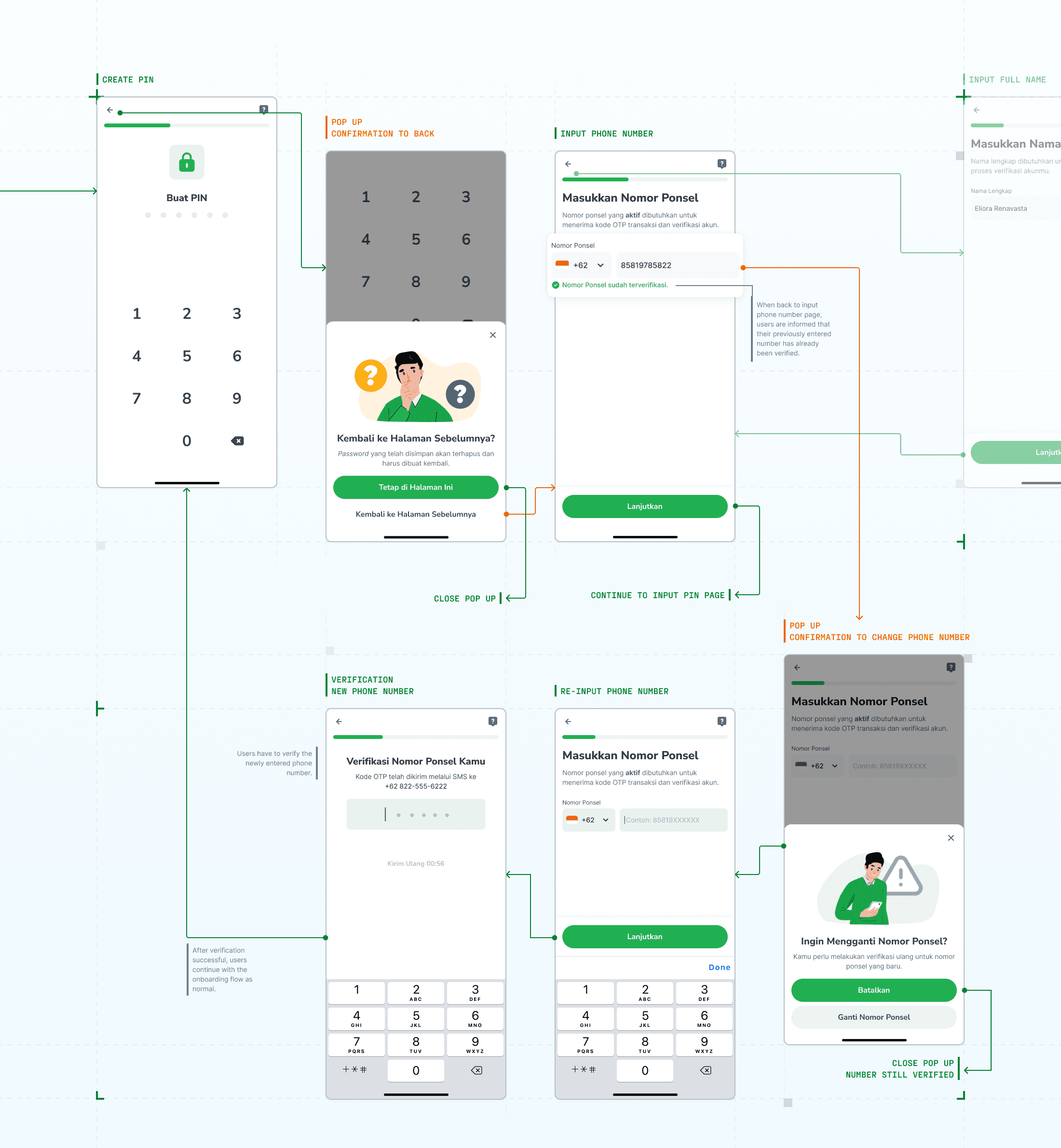
Snippet of detailed back navigation flow.
Error Cases at Each Journey Step
As part of the process, with the Product Manager I reviewed every input field to establish detailed requirements. This involved identifying potential errors and defining the most appropriate responses for each case. Some errors were common across multiple inputs, while others were specific to certain situations. Once all error‑handling flows were finalized, I ensured that each one was properly documented into each section of the design handover.
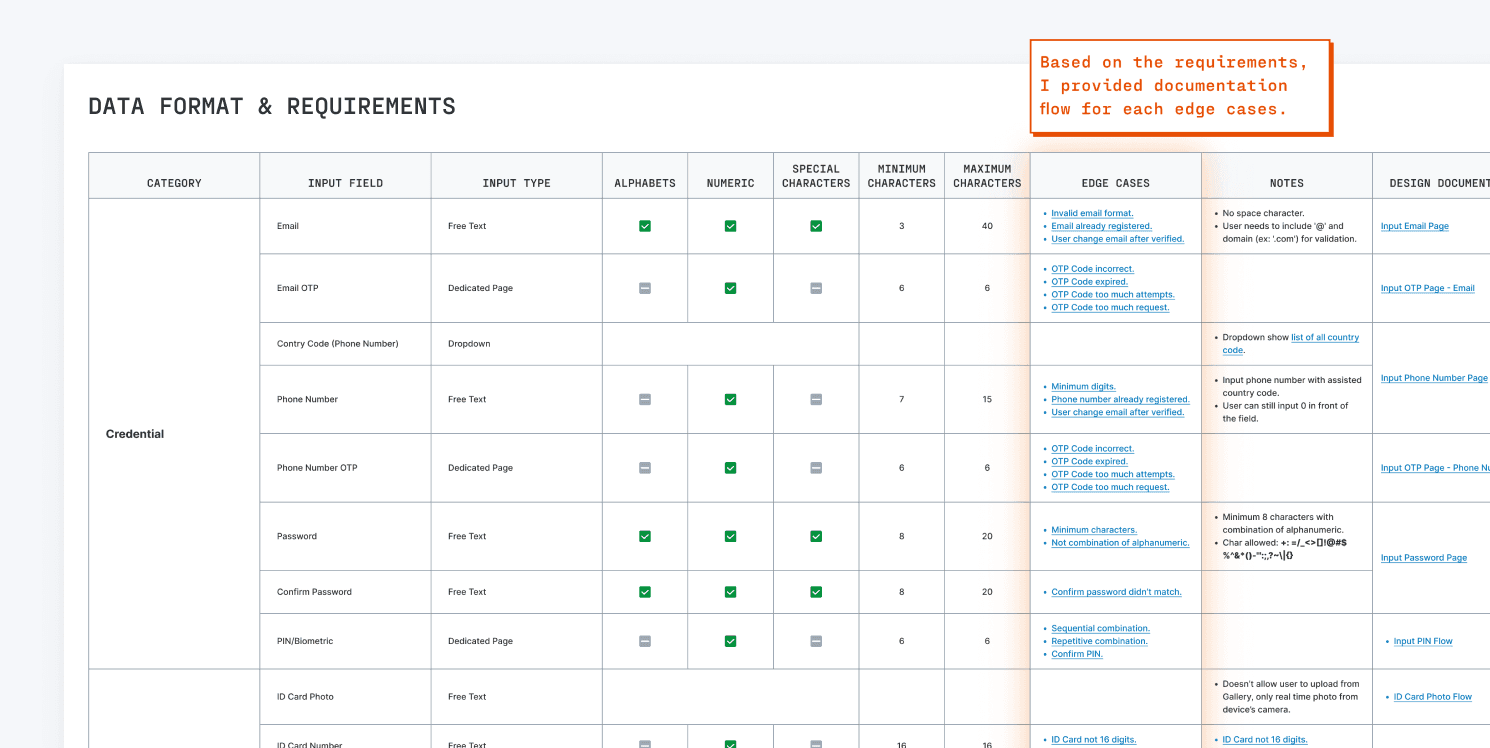
Detailed requirements with error/edge cases to cover.
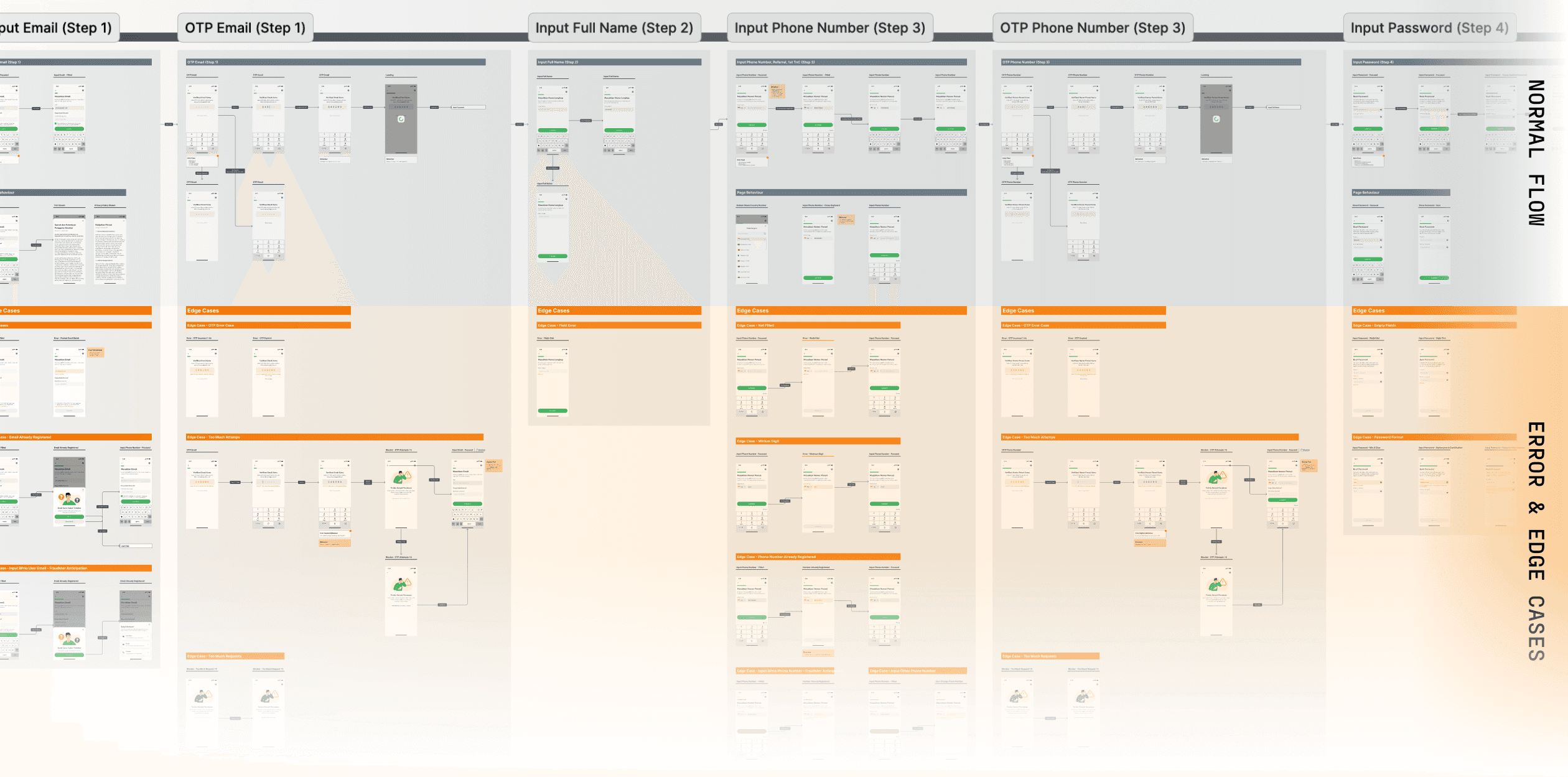
The design documentation includes both the normal and error flows.
Verification Status and Rejection Flow
During the verification process, users only need to wait while their submitted data is being reviewed. To keep users informed and reassured, the system displays the progress of each verification stage directly on the homepage and within a dedicated registration status page. This page allows users to see which investment products they have registered for and how far along each verification process has progressed.
In the case of a rejection, users are notified through in-app notifications and updated status indicators on the homepage. They are clearly informed about which data was rejected, along with the specific reason, and guided through the steps to correct it. The modular structure of the onboarding flow once again proves valuable, as engineers can easily reuse and slightly modify existing components from the initial onboarding journey for the data correction flow.
Below is an example of the user verification journey, highlighting how the design clearly communicate and inform user's verification status. It demonstrates how users are informed about ongoing processes, notified of any rejected verifications, and guided on the next actions they need to take to complete their onboarding.
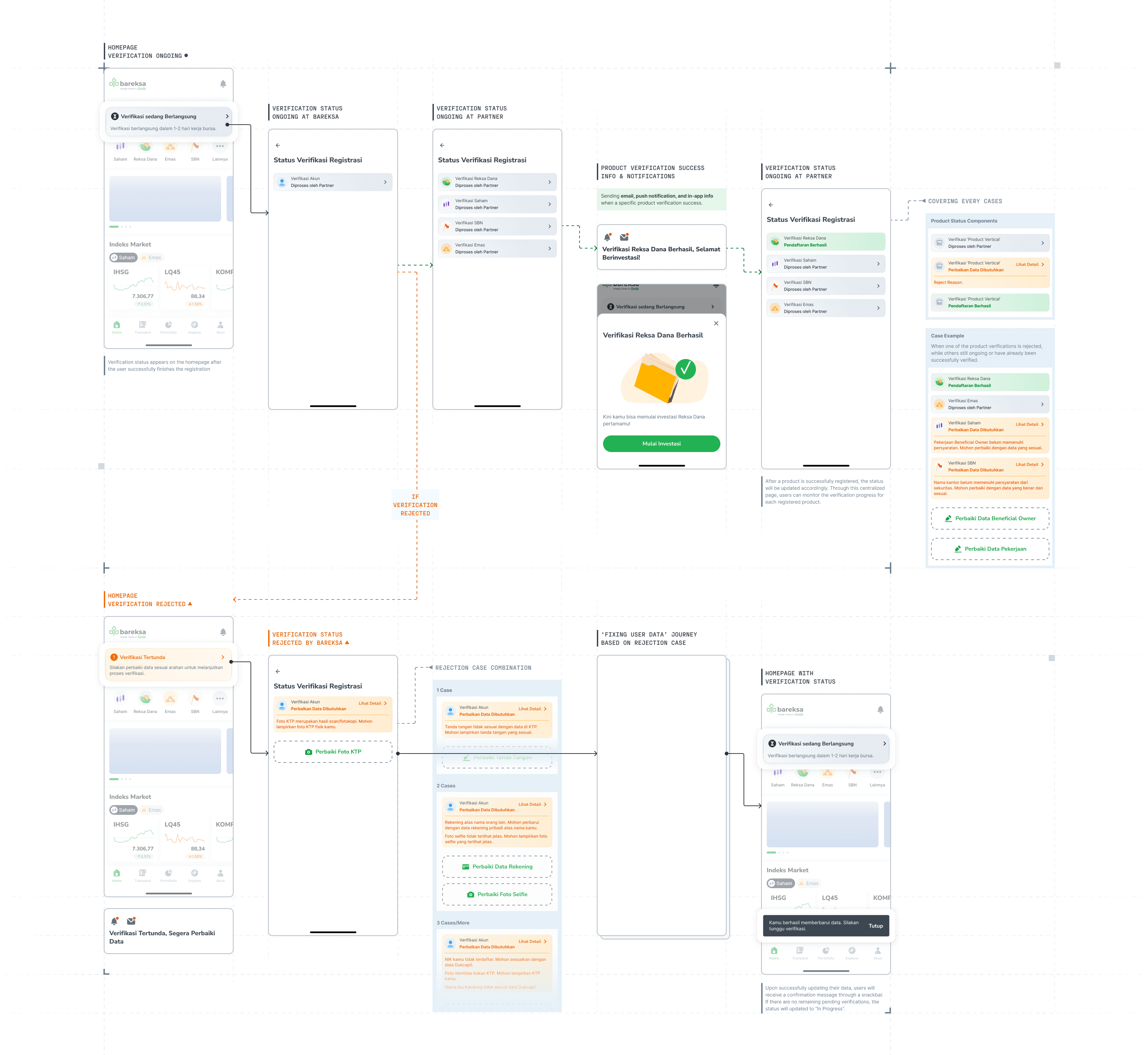
Detailed verification status and data fixing journey.
2nd Product Registration
The onboarding journey does not end after users complete their first product registration. Many Bareksa users, once verified for one investment product, continue exploring and investing in other products. To support this behavior, we designed a dedicated flow called 2nd Product Onboarding, which allows existing users to seamlessly register for additional products without going through the entire process from the beginning.
The key challenge was determining the optimal entry point for users to begin their second onboarding journey. Users should still be able to explore and learn about other investment products freely, but once they reach specific actions such as attempting to invest, they are prompted to complete the KYC for that product.
The 2nd Product Onboarding flow reuses previously verified user data stored in Bareksa’s system. Instead of asking users to re-enter all their information, the system displays a data preview page that shows the existing verified data and requests user consent before proceeding. Users are then only required to fill in the missing or product-specific data needed for that particular product’s KYC.
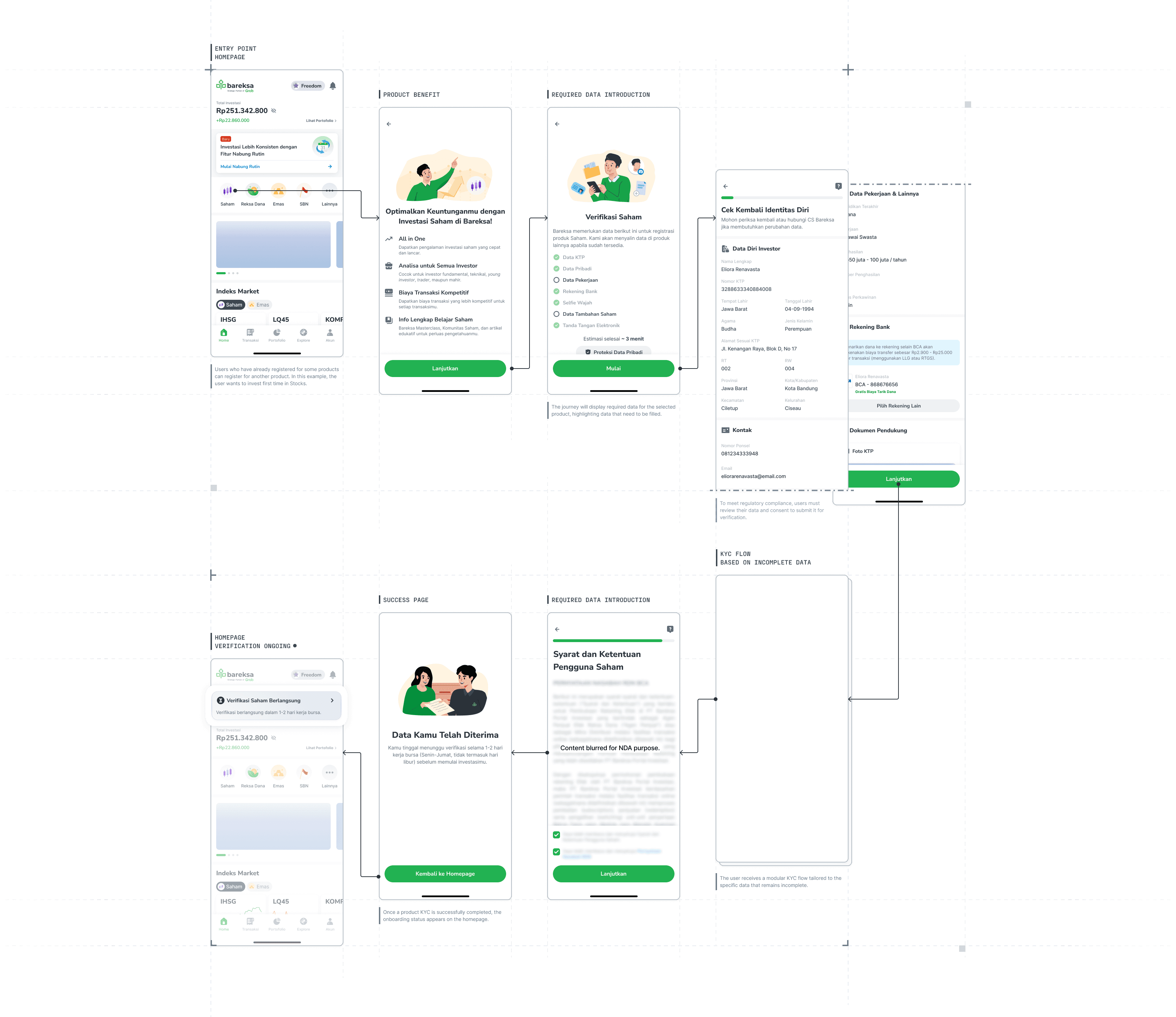
Flow overview of the 2nd Product Onboarding, existing verified data is reused to simplify the registration.
OUTPUT
Impact After the Revamp
The new onboarding flow was launched to all users in early 2024 as a cornerstone initiative to unify all investment products, create a smoother and more reassuring experience with modular KYC structure that eliminated redundant data input. Here are the highlighted impact results within the half-year after the release:
Total onboarding completion rate increased by 21%.
90% of users chose all products during their first-time onboarding.
Related issue tickets for the operations team were reduced by almost half, supported by the improved verification and rejection flow.
From the internal team’s perspective, the onboarding revamp introduced a structural change that improved operational efficiency. The product, engineering, and operations teams now work on a shared framework that simplifies iteration and maintenance. Verification issues that previously required manual handling were reduced significantly, and engineers could quickly reuse or adjust existing modules when changes to onboarding were needed.
Unexpectedly, the modular system proved its value almost immediately, not because of a new investment product, but due to the introduction of USD assets. These required additional bank account verification and technical integrations. Thanks to the modular foundation, the team was able to adapt the flow with minimal configuration, demonstrating the scalability and flexibility of the new system in real business scenarios.